
Table of Contents
- Natural vs Conventional Skincare: A Side-by-Side Comparison
- How to Read Skincare Ingredient Labels Without Getting Fooled
- Common Synthetic Ingredients to Avoid (and Why)
- Efficacy and Clinical Performance: What the Evidence Shows
- Shelf Life, Stability, and Cost-per-Use Analysis
- Transitioning to a Natural Skincare Routine Without Irritation
- Synergistic Formulations: When Natural and Conventional Work Together
- Conclusion: Choosing What Works for Your Skin
- Frequently Asked Questions
Last Updated: September 17, 2026
Natural vs Conventional Skincare: A Side-by-Side Comparison
Natural skincare is not automatically gentler, and conventional skincare is not automatically stronger. The real difference comes down to formulation quality, preservative systems, and how each product interacts with your skin barrier function.
How We Evaluated These Two Approaches
We scored both categories on five criteria: ingredient transparency, dermatological efficacy, shelf-life stability, skin type compatibility, and cost per use. No single category wins outright.
| Criteria | Natural Skincare | Conventional Skincare |
|---|---|---|
| Ingredient transparency | High when sourcing is disclosed | Varies widely |
| Dermatological efficacy | Strong for barrier support and soothing | Strong for targeted actives |
| Shelf-life stability | Shorter, depends on preservative systems | Longer, synthetic stabilizers |
| Skin type compatibility | Good for sensitive and reactive skin | Broad, but higher irritation risk for some |
| Cost per use | Higher upfront, fewer additives | Lower upfront, more filler ingredients |
How to Read Skincare Ingredient Labels Without Getting Fooled
Reading an ingredient label starts with the order of the list. Under U.S. labeling conventions, ingredients appear in descending order of concentration down to 1%, and anything at or below 1% can be listed in any order. That is why the first five entries tell you what the product mostly is, and why highlighted botanical extracts often sit near the bottom.
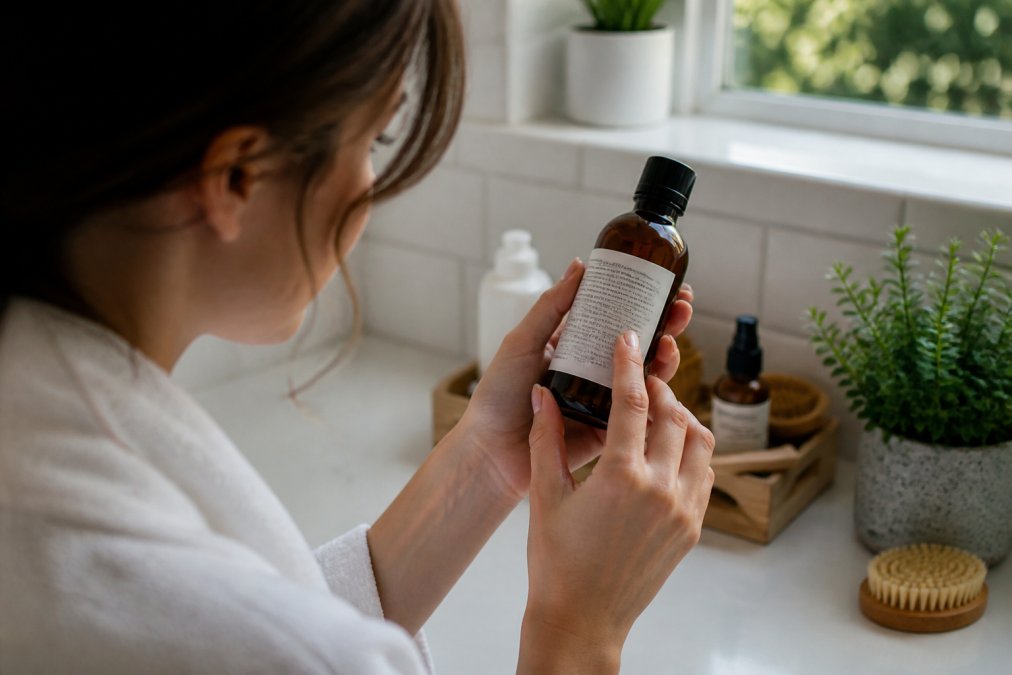
A few things to check every time:
- Ingredient order: The first five ingredients make up most of the formula. Everything after the 1% mark is essentially a rounding error.
- INCI names: Ingredients are listed by their International Nomenclature Cosmetic Ingredient name. "Tocopherol" is vitamin E, "ascorbic acid" is vitamin C, and "aqua" is water.
- Fragrance and parfum: These catch-all terms can hide dozens of undisclosed compounds and are a leading cause of contact dermatitis.
- Preservative systems: Every water-based product needs preservation. "Preservative-free" on a water-based serum is a red flag. Anhydrous (water-free) products like balms and oils can legitimately skip preservatives because bacteria need water to grow.
- Active vs. inactive: On products that make drug claims, sunscreen, acne treatments, anti-dandruff shampoos, the label separates "active ingredients" from "inactive ingredients." This split does not exist on cosmetics.
- Marketing terms: Words like "clean," "pure," "non-toxic," and "toxin-free" have no legal definition in the United States. "Organic" is regulated only for agricultural ingredients under the USDA National Organic Program, it says nothing about a finished cosmetic's safety or efficacy.
The Greenwashing Audit: Spotting Empty Claims
Run this quick audit before you trust a "natural" claim. It takes two minutes and saves you from paying a premium for a marketing story.
- Does the brand disclose where its botanical extracts are sourced?
- Are preservatives listed honestly, or does the brand claim none are needed?
- Is the word "chemical" used to imply danger? Water is a chemical.
- Does the brand publish full ingredient lists, or only "key ingredients"?
- Are certifications named specifically, or is it a vague "clinically tested" badge?
- Does the brand use "chemical-free" anywhere? That claim is impossible, every substance, natural or synthetic, is a chemical.
- Are "free-from" claims stacked up (paraben-free, sulfate-free, phthalate-free) without any explanation of why those ingredients were included in the first place?
Common Synthetic Ingredients to Avoid (and Why)
Not every synthetic ingredient is a problem, some are essential for product safety. But a handful are worth avoiding, especially for sensitive skin.
- Synthetic fragrance (parfum): A common trigger for contact dermatitis and irritation, and the blend is rarely disclosed.
- Parabens: Used as preservatives. Many people choose to avoid them, though regulatory bodies consider them safe at current levels.
- Phthalates: Often hidden inside fragrance blends, used to make scent last longer.
- Sulfates (SLS, SLES): Effective cleansers that can strip the skin barrier and leave skin tight or dry.
- Petroleum-derived emollients: Occlusive ingredients that sit on top of skin rather than supporting barrier repair.
- Synthetic dyes: Added for color only, and a frequent irritant for reactive skin.
Efficacy and Clinical Performance: What the Evidence Shows
Conventional skincare often leads on targeted actives with decades of clinical trials behind them. Natural skincare leads on barrier support and soothing when the formula is well built.
Bioavailability, pH Balance, and Skin Barrier Function
Bioavailability describes how much of an active ingredient your skin can absorb and use. Molecular structure matters: some botanical extracts penetrate well, while others sit on the surface.
Shelf Life, Stability, and Cost-per-Use Analysis
Shelf-life stability is the trade-off most natural skincare buyers underestimate. Water-based natural products without a strong preservative system can spoil faster, and botanical extracts can lose potency through oxidative stress.
What Actually Determines Shelf Life
Three variables drive shelf life:
- Water activity. Water-based products (creams, lotions, serums, cleansers) are the most vulnerable because water is a growth medium for bacteria, mold, and yeast. Anhydrous products, balms, oils, butters, are far more stable because microbes cannot reproduce without water.
- Preservative system. Conventional formulas typically rely on broad-spectrum synthetic preservatives like phenoxyethanol, sodium benzoate, or parabens, which are well-studied and predictable. Natural formulas often use weaker systems like vitamin E (tocopherol), rosemary extract, or potassium sorbate, which work but with a shorter effective window.
- Oxidation exposure. Unsaturated oils, rosehip, evening primrose, flaxseed, grapeseed, go rancid faster than saturated ones like tallow, coconut, or jojoba. Antioxidants like tocopherol slow this down but do not stop it. Once an oil smells sharp or "off," it has oxidized and should be replaced.
A practical rule of thumb: anhydrous balms and oils can stay stable for 12-24 months unopened and 6-12 months after opening. Water-based natural creams and serums are often closer to 6-12 months unopened and 3-6 months after opening. Conventional water-based products frequently carry 24-36 month unopened shelf lives because their preservative systems are more robust.
Running the Cost-per-Use Math
Cost-per-use is the metric that levels the playing field, but most guides mention it without doing the arithmetic.
Transitioning to a Natural Skincare Routine Without Irritation
Switching to a natural skincare routine too fast is the most common cause of irritation. Dermatologists recommend introducing one product at a time, giving skin one to two weeks to adjust before adding the next.
A practical transition plan:
- Week 1-2: Replace your cleanser only. A gentle oil-based cleanser removes makeup and excess oil without stripping the barrier.
- Week 3-4: Add a moisturizer or balm. Apply sparingly and build up.
- Week 5-6: Swap in any treatment or targeted product.
- Throughout: Patch test every new product and stop if you see persistent redness or stinging.
Synergistic Formulations: When Natural and Conventional Work Together
The most effective routines are rarely all-natural or all-conventional. They are built around what each product does best.

Conclusion: Choosing What Works for Your Skin
The natural versus conventional debate has no single winner. What works is a routine built on well-made formulas, honest labels, and products that respect your skin barrier: gentle cleansing, barrier-supporting moisture, and actives introduced slowly.
Frequently Asked Questions
Is natural skincare actually better than chemical skincare?
Neither approach is universally better. Natural skincare often uses botanical extracts and bioactive compounds that can support skin barrier function, but conventional formulas may deliver faster results for concerns like acne or hyperpigmentation. The best choice depends on your skin sensitivity, goals, and how your skin responds to active ingredients. Many people find success combining both approaches.
What should I look for on a label to determine product efficacy?
Check for active ingredients listed near the top, their concentrations if disclosed, and whether the formula includes preservative systems that protect shelf-life stability. Look for dermatologist-tested or hypoallergenic claims backed by clinical trials when possible. Avoid vague terms like 'natural' without context. Brands that practice label transparency list full INCI names and explain ingredient sourcing.
How do I transition to a natural skincare routine without causing irritation?
Start by replacing one product at a time, beginning with your cleanser. Patch testing on your inner arm for 48 hours helps identify skin sensitivity before applying to your face. Allow 1-2 weeks for your skin to adjust, especially if you are switching to formulas without synthetic stabilizers. Keep a simple routine and introduce new items gradually to isolate any reactions.
What are the most common synthetic ingredients to avoid if I have sensitive skin?
Common synthetic ingredients to avoid include synthetic fragrance, petroleum-derived ingredients, parabens, phthalates, and sulfates. These can disrupt skin barrier function or trigger irritation in sensitive individuals. However, not all synthetic ingredients are harmful; some synthetic stabilizers and preservatives prevent bacterial growth. Focus on avoiding ingredients you have personally reacted to and choose products with transparent labeling.
Can natural skincare provide the same anti-aging results as conventional formulas?
Natural formulas with ingredients like rosehip, argan, and frankincense oils can support skin hydration and may help reduce the appearance of fine lines over time. However, conventional anti-aging products often contain retinoids and peptides with more clinical trials backing their long-term efficacy. A synergistic formulation combining botanical extracts with proven actives can offer both gentle care and visible results.
Choosing skincare is harder than it should be, because the label rarely tells you what the formula actually does. If you want products built around pure, plant-based botanical ingredients and free from harsh chemicals and artificial toxins, Wellnessandnaturalskin is worth a look. Our formulas are crafted to restore skin health, calm the mind, and promote a radiant, healthy complexion. Get started with Wellnessandnaturalskin and find a routine that works with your skin, not against it.