
Table of Contents
- Quick Comparison: Premium Plant Based Skincare Picks for 2026
- Plant Based Skincare for Anti Aging: What Actually Works
- The Best Vegan Face Cream for Mature Skin (and How to Choose)
- How to Layer Plant Based Serums Without Wasting Actives
- Your 7-Step Premium Plant Based Skincare Routine for 2026
- What to Ignore: Clean Beauty Myths and Greenwashing Flags
- Conclusion: Building a Routine You Will Actually Keep
- Frequently Asked Questions
Last Updated: September 22, 2026
Quick Comparison: Premium Plant Based Skincare Picks for 2026
Building a premium plant based skincare routine in 2026 starts with knowing which formulas earn their place on your shelf. This guide from Wellnessandnaturalskin breaks down seven steps, the ingredients that actually support mature skin, and how to layer without wasting money.
Here's the short version before we go deeper:
| Product | Price | Best For | Key Actives |
|---|---|---|---|
| Cleansing Oil | $19.97 | All skin types, sensitive | Argan, jojoba, rosehip, blue tansy |
| Pre- & Probiotic Jelly Mist | $40.00 | Hydration, free-radical defense | Pre- and probiotics |
| Pre- & Probiotic Peptide Serum | $40.00 | Plumping, layering under makeup | Peptides, probiotics |
| Advanced Brightening Moisturizer | $38.00 | Barrier support, dullness | Hyaluronic acid, ceramides, vitamin C |
| Supernutrient Oil | $36.00 | Firming, locking in moisture | Pumpkin seed peptides, 3% vitamin C |
| Vitamin C Clay Mask | $39.00 | Weekly brightening, congestion | Turmeric, Kakadu plum, Australian clay |
Plant Based Skincare for Anti Aging: What Actually Works
Plant based skincare for anti aging works when botanicals deliver measurable actives, not just pleasant scents. Antioxidants, peptides, and fatty acids from plants can support collagen, calm inflammation, and defend against environmental stress. The difference between a formula that performs and one that just smells like a garden comes down to three things: which molecule is doing the work, how much of it is in the bottle, and whether it plays well with your other products.

Phytonutrients and Antioxidant-Rich Botanicals That Support Collagen
Phytonutrients are the compounds plants produce to protect themselves, and several of them translate into real skin benefits. Vitamin C from Kakadu plum and desert lime helps defend against oxidative stress that breaks down collagen over time. Turmeric brings curcumin, a well-studied antioxidant. Pumpkin seed peptides and cloudberry oil appear in formulas designed to support elasticity.
Retinoid Alternatives in Plant-Derived Formulas
Retinoid alternatives are plant-derived ingredients that encourage smoother, brighter-looking skin without the peeling and redness prescription retinoids often cause. Bakuchiol is the best known. Gentle exfoliating acids from botanical sources, like the glycolic and lactic acids in some brightening serums, do similar work by speeding up surface cell turnover.
How Plant Actives Interact With the Rest of Your Routine
This is where most plant-based routines quietly fail. Botanical actives are not inert, and a few pairings work against you:
- Bakuchiol plus retinoids. Both push cell turnover. Stacking them in the same session raises irritation risk without adding benefit. Alternate nights instead.
- Vitamin C plus exfoliating acids. Both sit at a low pH. Layering them back-to-back can sting, especially on reactive skin. Acids at night, vitamin C in the morning.
- Antioxidant oils plus water-based serums. Oil applied first creates a film that blocks the water-based serum underneath. Always water first, oil last.
- Niacinamide plus strong acids. Generally fine at cosmetic concentrations, but if your skin flushes easily, separate them by at least 30 minutes.
A Note on Patch Testing Botanical Sensitivities
"Natural" does not mean "non-irritating." Essential oils, plant extracts, and botanical fragrances are among the most common contact allergens in skincare. Before adding a new plant-based active to your full routine, apply a small amount behind your ear or on your inner forearm, wait 24 hours, then repeat on a second day. If you see redness, itching, or bumps, stop.
Seasonal Adjustments for a Plant-Based Anti-Aging Routine
Plant-based formulas behave differently depending on humidity and temperature. In cold, dry months, swap a lightweight gel serum for a lipid-rich cream and add a face oil as the final step to reduce water loss. In hot, humid months, drop the oil, switch to a lighter moisturizer, and move exfoliating acids to once a week to avoid over-stripping. The actives stay the same; the delivery format changes with the season.
The Best Vegan Face Cream for Mature Skin (and How to Choose)
The best vegan face cream for mature skin is one built around barrier repair, not just moisture. Mature skin loses lipids faster, so ceramides, cholesterol, and fatty acids matter more than a rich texture.
Barrier Repair, Ceramides, and Hydration for Mature Skin
Your skin barrier is the outermost layer that keeps water in and irritants out. When it weakens, skin looks dull, feels tight, and reacts to products it once tolerated. Ceramides, cholesterol, and fatty acids rebuild that layer. Hyaluronic acid pulls water into the skin, while occlusive oils seal it there.
How to Layer Plant Based Serums Without Wasting Actives
Layer plant based serums from thinnest to thickest, and give each one a moment to absorb. Water-based serums go first, oils and creams last. Get the order wrong and the heavier product blocks the lighter one from reaching your skin.
Here's the sequence that works:
- Cleanse and pat dry
- Mist or tone while skin is still slightly damp
- Water-based serum (peptides, probiotics, vitamin C)
- Moisturizer to seal in hydration
- Face oil as the final seal
Why pH and Vehicle Matter More Than Order Alone
Vitamin C in its L-ascorbic acid form needs a low pH to stay stable and penetrate. Peptides prefer a more neutral environment. If you apply a low-pH vitamin C serum and immediately follow with a peptide serum, you can shift the pH under the peptide and reduce how much of it absorbs. The fix is simple: give each serum 60 to 90 seconds to settle before the next layer, and don't mix a low-pH active with a peptide in the same session if you can avoid it.

Ingredient Interactions to Watch For
- Vitamin C plus benzoyl peroxide. The peroxide oxidizes the vitamin C, turning it orange and inactive. Use one in the morning and the other at night.
- Retinol plus alpha hydroxy acids. Both increase cell turnover. Same-night use multiplies irritation. Alternate nights.
- Bakuchiol plus retinol. Same logic as above. Pick one per session.
- Niacinamide plus vitamin C. Older guidance warned against this pairing, but at cosmetic concentrations most people tolerate it fine. If you flush easily, separate them.
How Many Actives Is Too Many?
The thing nobody tells you about layering is that more isn't better. Two serums with competing actives can cancel each other out or irritate skin. Pick one treatment serum per routine and let it do its job. A workable structure for most people:
Cleansing Oil: Facial Cleanser for All →
- Morning: antioxidant serum (vitamin C or a botanical equivalent) plus moisturizer plus SPF
- Evening: one treatment (retinoid alternative, exfoliating acid, or a brightening mask) two to three nights a week, plus moisturizer and optional oil
Your 7-Step Premium Plant Based Skincare Routine for 2026
A seven-step routine covers everything skin needs without overloading it. The split is simple: five steps in the morning, three at night, with cleansing counted twice because the evening version uses two products.
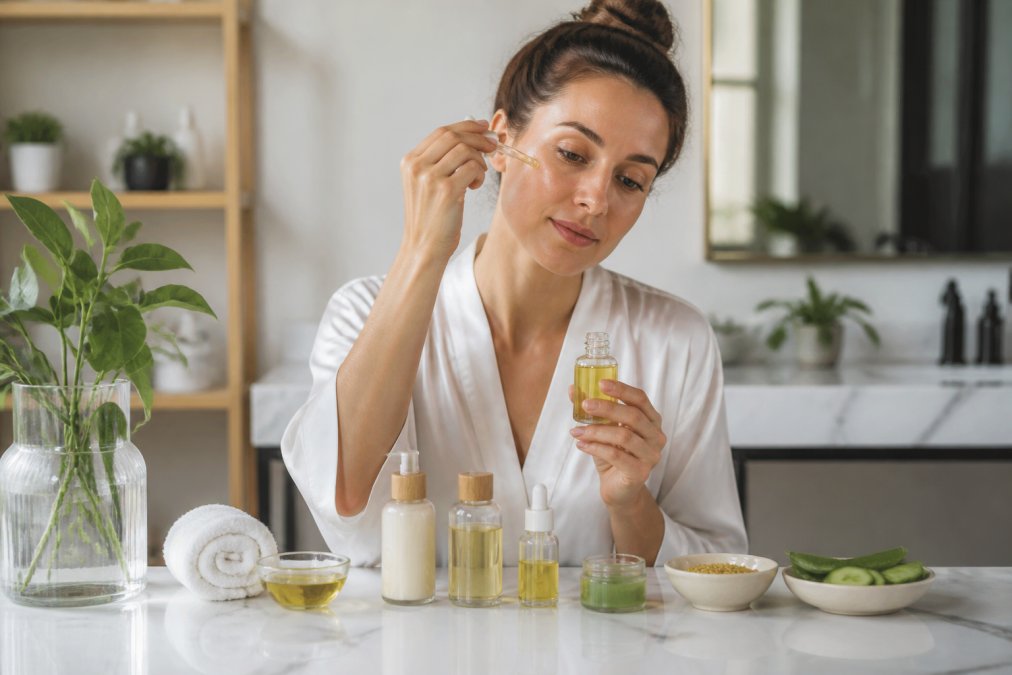
AM Routine: Cleanse, Mist, Serum, Moisturize, Protect
Morning is about hydration and defense.
- Cleanse. A gentle oil cleanser lifts overnight buildup without stripping. Wellnessandnaturalskin's Cleansing Oil ($19.97) uses argan, jojoba, and rosehip to dissolve impurities while supporting the barrier.
- Mist. A pre- and probiotic jelly mist hydrates and helps defend against free radicals.
- Serum. A plumping peptide serum layers cleanly under makeup.
- Moisturize. A ceramide-rich cream locks in water.
- Protect. Mineral SPF finishes the routine. This step is not optional.
PM Routine: Double Cleanse, Treat, Seal
Evening is about repair.
- Double cleanse. Oil first to remove sunscreen and makeup, then a second pass to clear the day's buildup.
- Treat. Alternate a brightening mask or an exfoliating serum two to three nights a week.
- Seal. A nutrient oil like the Supernutrient Oil ($36.00) locks in everything underneath and supports elasticity overnight.
That's seven steps total. The whole routine takes about five minutes in the morning and four at night.

What to Ignore: Clean Beauty Myths and Greenwashing Flags
"Clean beauty" has no legal definition, which means any brand can print it on a label. What matters is what's inside the bottle and whether the claims can be checked.
Watch for these flags:
- "Chemical-free." Water is a chemical. This phrase signals marketing, not science.
- Vague sourcing claims. "Ethically sourced" means nothing without a named supplier or certification.
- Fragrance as a catch-all. Synthetic fragrance is a common irritant, and "natural fragrance" isn't automatically gentler.
- No ingredient list at all. A brand that won't publish full ingredients is hiding something.
Ignore the word "natural" on the front of the bottle. Read the back. If the botanical actives aren't in the top half of the ingredient list, they're likely there for the label, not your skin.
Conclusion: Building a Routine You Will Actually Keep
The hardest part of any premium plant based skincare routine isn't finding the right products. It's sticking with them long enough to see results, which usually takes several weeks of consistent use.
Frequently Asked Questions
What is the best plant based skincare routine for anti-aging in 2026?
A strong plant based skincare routine for anti aging pairs antioxidant-rich botanicals with barrier support. Start with a gentle cleansing oil to remove makeup and impurities, follow with a pre- and probiotic serum, then a moisturizer with hyaluronic acid and ceramides. Seal with a nutrient-dense face oil at night and always finish your morning routine with mineral SPF. Consistency matters more than the number of products you use.
What is the best vegan face cream for mature skin?
Look for a vegan face cream with ceramides, peptides, and hyaluronic acid to support barrier repair and hydration. The Advanced Brightening Moisturizer at $38 uses hyaluronic acid, ceramides, and electrolytes alongside vitamin C and botanical brighteners.
How do I layer plant based serums correctly?
Apply thinnest to thickest. Start with a watery serum or jelly mist after cleansing, then move to a peptide or pre- and probiotic serum, then a moisturizer, and finish with face oil to seal everything in. Wait 30 to 60 seconds between layers so each product absorbs. If you use an acid-based night serum, apply it first on clean skin, then follow with a barrier cream. This order keeps active ingredients working without pilling.
How do I patch test botanical skincare if I have sensitive skin?
Apply a small amount behind your ear or on your inner forearm and wait 24 to 48 hours before using it on your face. Botanical extracts and essential oils like blue tansy can trigger reactions in sensitive skin even when a formula is clean. Introduce one new product at a time, spaced a week apart, so you can identify what caused a reaction. Stop use if you notice redness, itching, or swelling.
Why do premium plant based skincare products cost more?
Higher prices reflect cold-pressed oils, ethically sourced botanical extracts, small-batch manufacturing, and third-party testing. A $19.97 cleansing oil or $40 serum costs more to produce than a mass-market formula using synthetic fillers. You are also paying for sustainable packaging, cruelty-free certification, and ingredient traceability. The trade-off is fewer fillers and more concentrated plant-derived actives per bottle.