
Table of Contents
- Why Natural Skincare Products Expire Faster Than You Think
- How Long Does Natural Skincare Last? Unopened vs. Opened Timelines
- How to Tell If Skincare Products Have Expired: 7 Warning Signs
- The Role of Natural Preservatives in Skincare and Product Safety
- Natural Skincare Storage Tips: A Practical Checklist for Longer Shelf Life
- How to Read Skincare Labels and Date Markings Like a Pro
- Conclusion: Making Natural Skincare Last Without Compromising Safety
- Frequently Asked Questions
Last Updated: October 5, 2026
Why Natural Skincare Products Expire Faster Than You Think
Natural skincare products expire faster because they often skip the strong synthetic preservatives in conventional formulas, leaving delicate plant oils and water-based blends exposed to air, light, heat, and bacteria.
If you have opened a jar of natural skincare and found it smelling strange two months later, you are not imagining things.
How Long Does Natural Skincare Last? Unopened vs. Opened Timelines
Natural skincare typically lasts 1 to 2 years unopened and 3 to 6 months after opening, depending on the formula. Water-based products spoil fastest. Oil-based products last longer but can still turn rancid.
Unopened Products: The Shelf Life Clock Starts Later
An unopened jar is in a kind of sleep. Air has not touched the formula. Bacteria has not had a chance to grow.
Most natural products hold up well here, often for a year or more. Keep them sealed, cool, and out of direct sun, and they will wait.
Opened Products: The Period After Opening (PAO) Rule
Once you break the seal, the countdown speeds up fast. This is where the period after opening matters most.
Every finger dipped into a jar introduces air, bacteria, and moisture; a water-based cream can start to change within weeks.
| Product Type | Unopened Shelf Life | After Opening | Why |
|---|---|---|---|
| Water-based cream or lotion | 1-2 years | 3-6 months | Bacteria grows fast in water |
| Serum (water-based) | 1-2 years | 3-6 months | Actives degrade with air exposure |
| Facial oil or serum oil | 1-2 years | 6-12 months | Oils resist bacteria but can go rancid |
| Balm or butter | 1-2 years | 6-12 months | Little to no water content |
| Clay or powder mask | 2+ years | 12+ months | No water means no microbial growth |
The pattern is simple: the more water in the formula, the shorter its life.
How to Tell If Skincare Products Have Expired: 7 Warning Signs
You can tell a natural skincare product has expired by checking for color changes, texture shifts, and smell differences. If any appear, stop using it, even if the label date has not passed. Your senses are the best tool here.
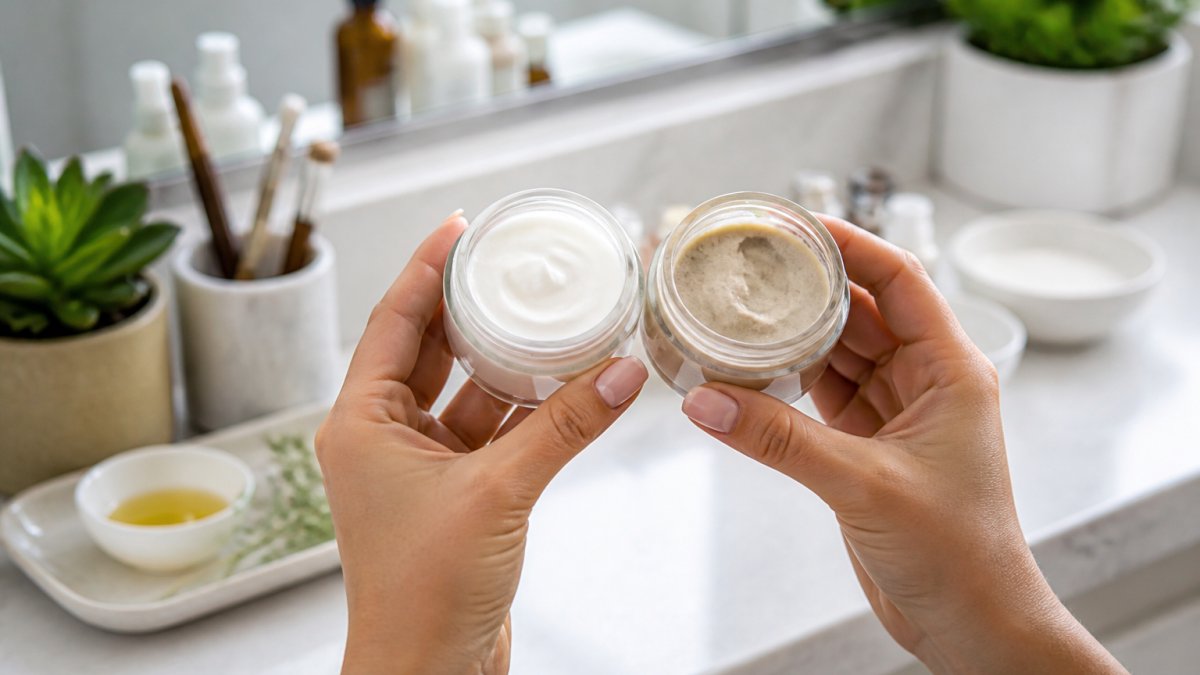
1. Color Changes and Discoloration
A white cream that turns yellow or brown is telling you something: oxidation, the same process that browns a cut apple.
Natural oils and botanical extracts are especially prone to this. Some color shift is normal, but a dramatic change means the formula has broken down.
2. Texture Shifts: Separation, Graininess, or Runny Formulas
Separation is a clear warning sign: liquid pooling on top of a cream, or a formula turned gritty, means it has lost its structure.
A runny product that used to be thick is another red flag, emulsions break down past their prime.
3. Smell Changes: Rancidity and Sour Odors
This one is hard to miss. Rancidity smells like old cooking oil, crayons, or something sour.
A fresh product should smell like its ingredients. If it smells off, it is off, do not power through.
Other signs to check:
- Mold or dark spots on the surface
- A change in how the product feels on your skin
- New irritation or redness where you applied it
The Role of Natural Preservatives in Skincare and Product Safety
Preservatives in skincare do two separate jobs, and confusing them is why so many people misjudge how long a natural product will last. Microbial preservation keeps bacteria, yeast, and mold from multiplying; antioxidant protection slows the reaction between oxygen and oils or actives that causes rancidity and lost potency.
Microbial Preservation: What Actually Keeps Water-Based Formulas Safe
Any formula containing water, lotion, cream, serum, gel, or micellar water, is a hospitable environment for microorganisms.
Common preservation approaches include:
- Organic acids such as sodium benzoate, potassium sorbate, and their naturally derived equivalents, which are effective in acidic pH ranges and often paired together for broader coverage.
- Polyols like pentylene glycol and propanediol, which both hydrate and provide some antimicrobial activity.
- Plant-derived actives such as certain extracts and ferments, which can support a system but rarely carry it alone.
A well-formulated natural product can use an effective preservation system. The trade-off is usually narrower pH tolerance, shorter effective windows, or the need for careful packaging, not an absence of protection.
Antioxidant Protection: A Different Job Entirely
Oil-based products, facial oils, balms, body butters, oil serums, generally do not support microbial growth because they contain little or no water.
Antioxidants such as tocopherol (vitamin E), rosemary extract, and green tea extract slow this process. They do not stop it.
This is why a preservative-free facial oil can still go bad within months, not because of microbes, but because of oxygen.
Why Preservative-Free Isn't Automatically Safer
A common assumption is that fewer preservatives mean a gentler, safer product.
Most cosmetic scientists treat adequate preservation as a safety requirement for any water-containing product, not an optional add-on. The question is not whether a product is preserved, but whether its system suits its water content, pH, packaging, and intended use.
What This Means for Shelf Life
Because natural preservation systems often have narrower effective ranges, natural water-based products tend to have shorter realistic windows after opening than conventional equivalents. Oil-based products avoid the microbial problem but face oxidation instead. Neither category is inherently unsafe, but both reward careful storage, clean handling, and attention to the period-after-opening guidance on the label.
Natural Skincare Storage Tips: A Practical Checklist for Longer Shelf Life
You can extend the life of natural skincare by controlling temperature, light, and air exposure. Store products cool, dark, and sealed, and always use clean hands or a spatula.
- Store products away from direct sunlight
- Keep jars and bottles in a cool, dry spot
- Tighten lids after every use
Temperature, Light, and Humidity: The Three Enemies of Stability
Heat speeds up every chemical reaction, including the ones that spoil your products. Light breaks down active ingredients. Humidity invites moisture and microbial growth.
A steamy bathroom is one of the worst places to store skincare. A cool, dark cabinet is far better.
Packaging Matters: Airless Pumps vs. Jars
Airless packaging keeps air out, slowing oxidation and contamination. Jar packaging looks lovely, but every scoop exposes the formula to air and bacteria.
If you have a choice, airless pumps keep products fresher longer; jars are fine but need extra care.
How to Read Skincare Labels and Date Markings Like a Pro
Most skincare labels carry two date signals answering two different questions. The expiration date ("exp" or "use by") tells you how long an unopened product remains stable. The period-after-opening (PAO) symbol tells you how long it stays good once you break the seal. Reading both correctly is the difference between tossing a product too early and using one that has already turned.
The Period-After-Opening Symbol
The PAO symbol is a small open-jar icon printed on the label or carton. Inside or beside the jar is a number followed by the letter M, such as 6M, 12M, or 24M, the manufacturer's estimate of how many months the product remains stable after first opening, assuming normal use and storage.
A few practical notes:
- The PAO clock starts the day you first open the product, not the day you buy it.
- A 6M symbol on a water-based cream means you have roughly six months from opening, not six months from purchase.
- The symbol is required on cosmetics sold in many markets, but enforcement and placement vary, so it is sometimes on the outer box rather than the jar itself.
Expiration and Use-By Dates
A printed expiration date or use-by date applies to the unopened product. Once opened, the PAO symbol generally takes over as the more relevant guide; if a product has both, the earlier of the two governs your decision.
"Best by" dates are a quality marker, not a safety deadline. A product past its best-by date may still be safe but could have lost potency, texture, or scent.
When There Is No Date at All
Many small-batch and indie natural products ship without a printed date. That does not mean they last forever. If you cannot find a date:
- Check the bottom of the jar, the crimp of the tube, and the outer carton, dates are often stamped in low-contrast ink.
- Note the date you opened the product on the container with a marker or a small sticker.
- Assume a conservative window: roughly 3 months for water-based products and 6 to 12 months for oil-based or anhydrous products, unless the brand states otherwise.
Batch Codes and Lot Numbers
Some brands print a batch code or lot number instead of a readable date. These are internal tracking codes, not consumer-facing expiration dates, and usually require the brand's help to decode. If a product has only a batch code and no PAO symbol, treat the conservative windows above as your default.
A Quick Label-Reading Checklist
- Find the PAO symbol (open-jar icon with a number and M)
- Look for a printed expiration or use-by date on the jar, tube, or carton
- Check the bottom and crimp for stamped dates
Why This Matters More for Natural Formulas
Because natural products often have shorter realistic windows, misreading or ignoring a PAO symbol costs more. A conventional cream might tolerate a few extra months past its marked window; a natural water-based cream may not. Knowing when the clock started, and what the manufacturer intended, is the most reliable way to avoid using something that has already turned.
Conclusion: Making Natural Skincare Last Without Compromising Safety
Natural formulas expire faster for good reasons.
That is not a reason to avoid them.
At Wellnessandnaturalskin, we craft our products with pure, plant-based botanical ingredients and formulas free from harsh chemicals and artificial toxins.
Shop now and find natural skincare made to restore your skin health, calm your mind, and support radiant, healthy skin.
Frequently Asked Questions
How long can you use skincare after the expiration date on your face?
It depends on the product and how it was stored. Water-based natural skincare products like creams and lotions should be discarded once they pass their expiration date or period after opening, because bacteria and mold can grow without visible signs. Oil-based products like facial oils may last a few weeks past their date if they still smell normal and show no color changes. If you notice any change in smell, texture, or color, stop using it immediately to avoid skin irritation or infection.
What is the 4-2-4 rule in skincare?
The 4-2-4 rule is a simple way to remember how often to replace certain products. It suggests replacing mascara every 4 months, liquid eyeliner every 2 months, and other liquid or cream products every 4 months after opening. For natural skincare specifically, check the period after opening symbol on the packaging. Most water-based natural formulas last 3 to 6 months once opened, while oil-based serums and facial oils can last 6 to 12 months if stored away from heat and light.
Do products with natural preservatives have a shorter shelf life?
Yes, generally. Natural preservatives in skincare like vitamin E, rosemary extract, and certain essential oils are less potent than synthetic preservatives at preventing microbial growth. This means water-based natural products often have a shorter shelf life, typically 6 to 12 months unopened and 3 to 6 months after opening. Oil-based formulas without water don't need preservatives for bacteria control, but they can still go rancid from oxidation. Always check the expiration date and store products properly to maximize their usable life.
Does natural skincare need to be refrigerated?
Not always, but refrigeration can extend shelf life for certain products. Vitamin C serums, retinol alternatives, and products with live cultures or fresh botanicals benefit most from cooler temperatures. For most natural skincare storage tips, a cool, dark cabinet away from direct sunlight and heat sources like radiators or bathroom counters is sufficient. Avoid storing products in the bathroom if it gets steamy, because moisture and temperature swings speed up spoilage. If you refrigerate, let the product come to room temperature before applying to avoid skin sensitivity.